A satellite link budget accounts for every gain and loss in a communications path: transmit power, antenna gains, free space path loss, atmospheric, polarization, pointing, and implementation losses. The output is the link margin: headroom above the signal-to-noise ratio required for the target bit error rate. Most operational space-to-ground links carry 3–6 dB of nominal margin.
Prefer watching? How to Build a Satellite Link Budget — self-hosted, no tracking.
Transcript
This is the link budget calculator on se.hitthosting.com: a free, in-browser tool that computes EIRP, free-space path loss, G over T, received C/N0 and Eb/N0, and the link margin that decides whether your data comes down.
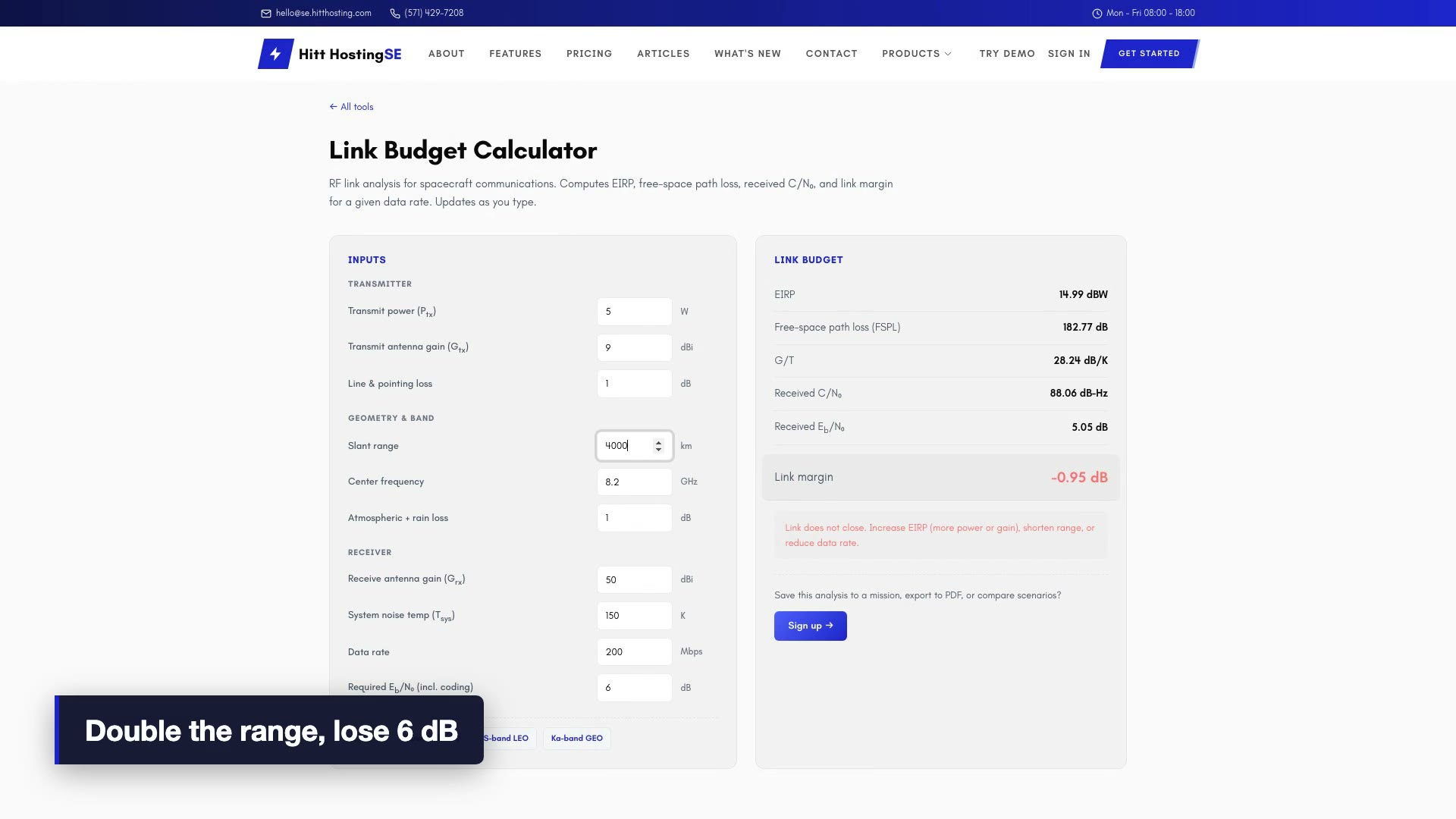
Loading the X-band LEO Earth-observation preset fills in a typical imaging smallsat downlink: 5 watts of transmit power, 3 dBi of transmit gain, 2,000 km slant range at 8.2 GHz, a 50 dBi ground antenna at 150 kelvin, and 200 megabits per second against a required Eb/N0 of 6 dB.
The margin comes out at minus 0.93 dB, and the tool says so plainly: the link does not close. That is the useful part. A link budget is not there to flatter a design, it is there to tell you when the design does not work.
The culprit is the transmit antenna. Three dBi is close to omnidirectional, which is not what a 200 megabit X-band downlink uses. Raising the transmit gain to 9 dBi, a modest directional patch, adds 6 dB of EIRP and the margin becomes plus 5.07 dB. Green, and comfortably above the 3 dB most missions design to for routine operations.
Free-space path loss is the dominant term in every budget. It is 20 log of range plus 20 log of frequency plus a constant, 92.45 when you work in kilometers and gigahertz. Doubling the slant range from 2,000 to 4,000 km costs 6 dB, and you watch the margin drop by exactly that.
Data rate separates C/N0 from Eb/N0. C/N0 is carrier power against noise density and does not care about your bit rate. Eb/N0 is per bit: subtract ten log of the rate. Raising the data rate to 800 megabits leaves C/N0 unchanged while Eb/N0 falls by 6 dB. That is why the same link supports a low rate comfortably and fails at a high one.
Atmosphere and rain go in as their own line. At X-band and below, one to two dB covers most conditions. At Ka-band you budget four to eight dB for high availability, which is why the Ka-band GEO preset carries 6 dB of atmospheric loss across a 39,000 km path.
The S-band LEO preset shows the opposite corner of the trade space: low power, low gain, and only 2 megabits per second, which closes easily. The Ka-band GEO preset shows the hard one: 200 watts and 36 dBi of transmit gain, and the range and rain still dominate.
The calculator is free, needs no account, and runs entirely client-side in your browser. The companion article covers the formulas, a table of required Eb/N0 by coding scheme, and a worked example.
What is a satellite link budget?
A satellite link budget is an accounting of every gain and every loss in a communications path from transmitter to receiver. The output is a single number, the link margin, that tells you how much headroom you have above the minimum signal needed for a useful bit error rate. If the margin is positive, the link closes. If it is negative, you do not have a working communications system.
The structure of every link budget is the same. Start with transmit power. Add transmit antenna gain. Subtract free space path loss. Add receive antenna gain. Subtract atmospheric losses, polarization losses, pointing losses, and implementation losses. Subtract the receiver noise floor. The result is the available signal-to-noise ratio. Compare it against the required signal-to-noise ratio for your modulation, coding, and target bit error rate. The difference is the margin.
How do you account for transmit power and antenna gain?
Transmit power is the easy part. It is the RF output of your transmitter in watts, expressed in dBW or dBm. A 5-watt X-band transmitter is +7 dBW or +37 dBm. The complication is that "transmit power" sometimes refers to the output of the high-power amplifier and sometimes refers to the power at the antenna feed. The difference is the loss in cables, switches, and waveguides between the amplifier and the antenna, typically 1-2 dB. Be explicit about which you are reporting.
Transmit antenna gain depends on the antenna type and pointing. An omnidirectional antenna has a nominal gain of 0 dBi. A 30-cm parabolic dish at X-band has about 25 dBi peak gain. The gain you should use in the link budget is not the peak gain; it is the gain in the direction of the receiver, which depends on pointing accuracy. A 1-degree pointing error on a 25-dBi dish at X-band can cost you 2 dB of effective gain.
How large is free space path loss?
Free space path loss (FSPL) is the dominant loss in most links. It depends on distance and frequency: FSPL_dB = 20 log10(d) + 20 log10(f) + 32.45, where d is in km and f is in MHz. At X-band (8 GHz), a 600-km LEO downlink has about 166 dB of FSPL. At Ka-band (32 GHz), it is 178 dB. Higher frequency means more path loss but also higher antenna gain per unit area, so the trade is not as one-sided as it looks.
What are atmospheric and polarization losses?
Atmospheric losses come from gaseous absorption (oxygen and water vapor) and rain. At X-band, gaseous absorption is typically 0.1-0.3 dB at low elevation angles. Rain attenuation at X-band is 1-3 dB for moderate rain rates. At Ka-band, rain attenuation can exceed 10 dB during heavy rain; this is why Ka-band links are usually designed with an availability target (e.g., 99.5% of the time) rather than worst-case rain.
Polarization losses arise when the transmit and receive antennas are not perfectly aligned in polarization. Linear-to-linear with a 5-degree mismatch costs about 0.03 dB. Linear-to-circular costs 3 dB by definition. Most operational links use circular polarization on both ends to avoid pointing-dependent polarization losses.
What are pointing and implementation losses?
Pointing losses are the difference between the peak antenna gain and the effective gain in the actual direction of the receiver. They depend on the antenna 3 dB beamwidth and the pointing error. For a Gaussian beam, the loss in dB is approximately 12 (theta_error / theta_3dB)^2. A pointing error half the 3 dB beamwidth costs 3 dB of gain.
Implementation losses bundle everything that is hard to model precisely: phase noise, intermodulation, filter ripple, quantization noise, and digital signal processing imperfections. Typical values are 1-2 dB at the modem level. They are not optional: leave them out and your link margin will look healthier than it really is.
How do G/T and required Eb/No set the receive side?
The receive system is characterized by a single figure of merit: G/T, the antenna gain divided by the system noise temperature, in dB/K. A 3-meter X-band ground station might have G/T around 30 dB/K. A typical NEN station has 38-45 dB/K. The required G/T for a given data rate is computed from the required Eb/No, the data rate, and the link's effective bandwidth.
Required Eb/No depends on modulation and coding. Uncoded BPSK at BER 10^-5 needs Eb/No around 9.6 dB. Add a rate-1/2 convolutional code and the requirement drops to around 4 dB. Add Reed-Solomon concatenation and you get to about 2.5 dB. Modern LDPC and turbo codes can approach 0.5 dB. Choosing the right coding is a major lever in any link budget; it can be worth 5-7 dB.
| Modulation and coding | Required Eb/No at BER 10^-5 |
|---|---|
| Uncoded BPSK | ~9.6 dB |
| BPSK + rate-1/2 convolutional code | ~4 dB |
| + Reed-Solomon concatenation | ~2.5 dB |
| Modern LDPC / turbo codes | approaching 0.5 dB |
What are the most common link budget pitfalls?
Common pitfalls: forgetting to account for slant range at low elevation angles (a ground station tracking to 5 degrees elevation sees about 2.5x the line-of-sight distance vs zenith), using nominal antenna gain instead of pointing-loss-adjusted gain, ignoring polarization mismatch when one end is linear, and reporting margin against typical conditions rather than worst case.
A useful sanity check: most operational space-to-ground links carry 3-6 dB of margin in nominal conditions. If your link budget shows 15 dB of margin, you have probably forgotten a loss term. If it shows -2 dB, you have probably been too pessimistic somewhere, but you also need to fix it before flight, not after.
Link budget analysis in Hitt Hosting SE
Hitt Hosting SE includes a Link Budget Calculator that walks through every term, lets you adjust modulation and coding, and reports both nominal and worst-case margins. Pair it with the Free Space Path Loss calculator and the Doppler Shift calculator for a complete communications analysis. Each calculator is parametric: change frequency or distance and every dependent value updates immediately.